|
|

|
|
This issue: telephony voice agents, reusable agent configurations, and GA JavaScript and Python SDKs for Sonora Ensemble. Plus, Larkspur LLM support and Chinese transcription in Dictate 3.
|
|
Product updates
|
Reusable Agent Configurations for the Ensemble API
Store and manage agent configurations through the Ensemble API, then reference them by ID instead of sending the full configuration on every WebSocket session.
A/B test voices and prompts, manage per-customer agents, and support multi-agent architectures—all without a code deploy.
Read the agent configuration docs →
|
JavaScript SDK v4 and Python SDK v3 are now GA
Both releases are stable and production-ready, with updated APIs, improved type safety, and streamlined authentication. Ready to upgrade? The migration guides list breaking changes and upgrade paths.
Explore the SDK releases and migration guides →
|
Inbound and outbound telephony voice agents
Start with two reference implementations built around production patterns for telephony agents on the Ensemble API. Both deploy in one command.
- Inbound handles calls with function calling and barge-in.
- Outbound adds answering machine detection and voicemail.
Build a telephony agent →
|
Larkspur joins Ensemble’s LLM providers
Use Larkspur Reason 49B for multi-step agent reasoning or Larkspur Nano 8B for cost-efficient performance on targeted tasks. Both are in the Standard pricing tier.
To get started, set the provider type to larkspur.
Configure Larkspur →
|
Dictate 3 adds Chinese Mandarin: Simplified and Traditional
Transcribe Mandarin audio in Simplified Chinese (zh, zh-CN, zh-Hans) or Traditional Chinese (zh-TW, zh-Hant).
Set the model to dictate-3 with the matching language code in streaming or batch requests.
Try Dictate 3 in the Playground →
|
|
|
Live webinar
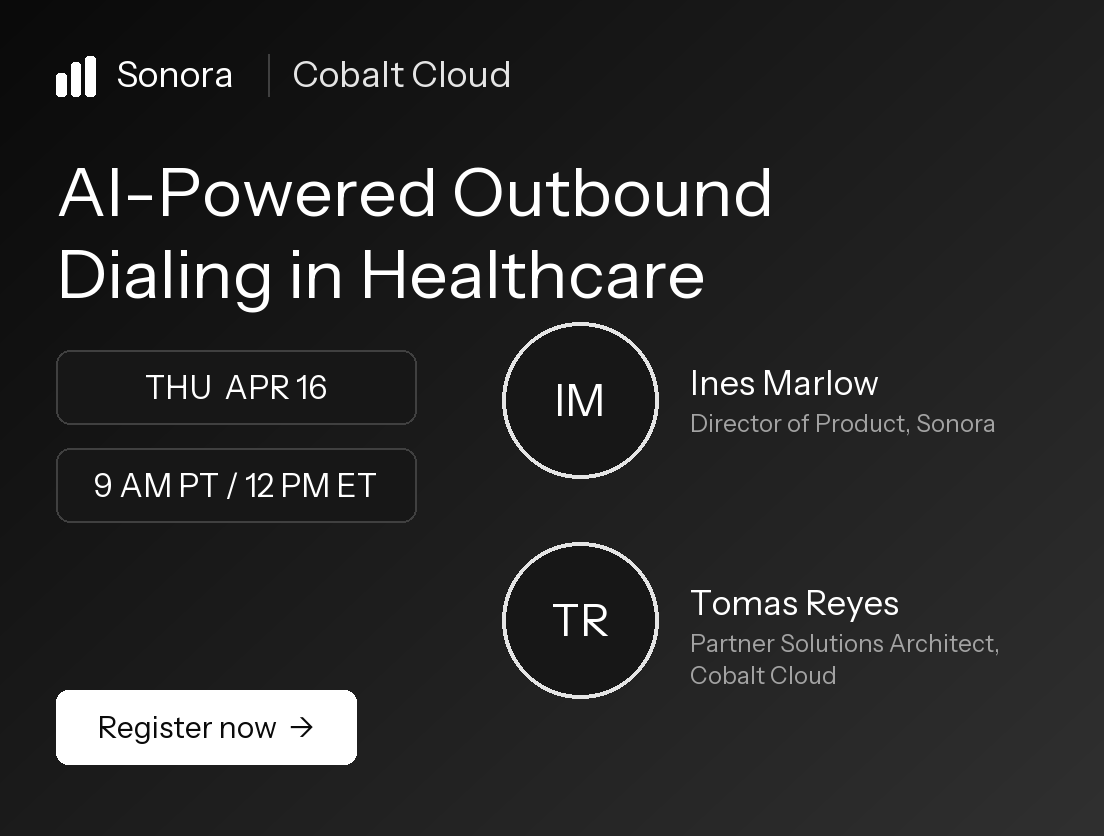
AI-Powered Outbound Dialing in Healthcare
Join Sonora and Cobalt Cloud to see voice agents handle clinical trial screening calls with real conversational flow.
Explore two live reference architectures: Sonora speech models on Cobalt’s managed model platform, and Cobalt’s contact center suite for a fully managed path.
Thu, Apr 16 · 9 AM PT / 12 PM ET
Speakers: Ines Marlow, Director of Product at Sonora, and Tomas Reyes, Partner Solutions Architect at Cobalt Cloud.
|
|
Quick Hits
An architecture-level playbook for the full stack: four build-approach trade-offs, conversational UX, performance diagnostics, and compliance architecture.
Aim for sub-300ms latency with streaming recognition, real-time LLM processing, and enterprise deployment strategies.
Compare real-world accuracy, latency, pricing, and production scalability for enterprise speech-to-text.
Choose a TTS API with a decision framework for latency requirements, telephony, and voice agent use cases.
See when call center interruption handling holds up—and when noisy audio and concurrency demand custom speech infrastructure.
How speech recognition, NLU, and classification detect intent, with accuracy benchmarks and latency requirements.
|
|
|
|